Wednesday, July 6, 2011

Letter to a French Class in the US

The third goal of Peace Corps is to help Americans understand the people and cultures of other countries. Peace Corps encourages volunteers to correspond with a class in the US. Last year I sent a letter to a friend who teaches French in a middle school in New Jersey. Each of her students wrote me a letter and asked lots of questions! I thought you might enjoy reading the letter I sent back to them:


June 2011

Dear Ms. Abraham’s Class,

Thank you for all of your letters! I really enjoyed reading them. I’m sorry I don’t have time to respond to every single one, but I answered some of your questions in this letter.

Most of you asked about what the weather is like here. Mali is in a region called the Sahel, which is next to the Sahara Desert. The weather is hot here all year round. The seasons here are different than in the United States; there is a rainy season (June-September) and a dry season (October-May). I have adapted to the hot climate by drinking lots of water, staying in the shade and resting in the middle of the day. There is a “cold” season (December-February), but it only gets cold at night, kind of like a cool night in the summer.

Malians’ favorite sport is soccer. There are some organized soccer teams and tournaments, but mostly the kids kick the ball around the neighborhood. There are no grass fields in Kenieba, so they play on the street or on a dirt field. Malians also like to play basketball. They also like to play games such as marbles, a card game similar to crazy eights, and checkers. Some kids like to make toys out of old trash. For example, one of my neighbors used an old sardine can, four plastic bottle caps and a piece of string to make a little car! I have also seen kids use old plastic bags and sticks to make kites.

There is a lot of different music in Mali. I enjoy listening to the traditional music. There are different instruments like the kora, a big stringed instrument. There are some singers called griots (gri-oh) who tell stories through music weddings and other social events. Malians love to hear songs of the stories of their ancestors. They also like to listen to American pop music from artists like Akon, Jay-Z and Rihanna. I even heard a Justin Bieber song the other day!

I live in a concrete house that has electricity, but it’s only on part of the day. I have to fetch water from the faucet on the street, do my own laundry and wash the dishes by hand, and go outside to go to the bathroom. The houses are close together in my neighborhood. My host family lives right next door. The center of Kenieba, where the market and bus station and big stores are located, is a five-minute walk away. There are little shops in my neighborhood that sell bread, condiments, cold drinks like Coke, and cleaning supplies.

I eat lunch every day with my host family and dinner most nights of the week with my work counterpart and his family. When I cook dinner for myself, I usually make American food like spaghetti with tomato sauce, salad, and mac and cheese. Malians typically eat porridge for breakfast, rice and sauce for lunch, and a different grain (like fonio, millet, or cornmeal) and sauce for dinner. There are vegetables for sale in the market but they aren’t available all year round. So sometimes we will eat vegetables with the meal and sometimes there won’t be any. The families are poor and can only eat what they grow. It’s hard to feed a big family, and most families have four, six, eight or more kids! They also eat fruits that are in season, like bananas, mangoes, papaya, and watermelon. My favorite food is called djouka, which is a mixture of ground up peanuts and a grain called fonio. It kind of looks like cous cous, and it is really good.

The school system in Mali is similar to ours in the US. There is an elementary school, middle school, and high school. Students need the same kinds of materials for school as you do, like pens, notebooks, textbooks, and homework! The schools are very crowded in Mali though, with three students sharing a desk. There are normally 50 to 100 students in a classroom. The school day starts at 8 AM and breaks for lunch at 12 PM, and then there is an afternoon period from 3 to 5 PM. The school year starts in October and ends in June. During summer vacation, which is rainy season here, the kids help plant and harvest their family’s crops in the field.

I knew when I joined Peace Corps that I would have to get used to a different lifestyle. It was hard at first to get used to living here, but my host family has been really nice and helpful. The Malians in my neighborhood were shy at first, but now they’re really friendly. They love to call out my Malian name, Younoussa Samaké, and greet me when I’m walking down the street. It has been hard to be away from home for a long time, but I have kept in touch with my family and friends back home since I’ve been here. I have also become friends with many Malians and other Peace Corps volunteers.

My job here is to help the local business owners and women’s associations improve their businesses. When I first arrived in Kenieba, I spent the first three months meeting the business owners and getting to know the mayor and other important people in town, and talked about how we could work together. I have worked the most with a women’s association that makes shea butter. Shea butter comes from the shea nut, which grows all over Mali. Shea butter is used in a lot of cosmetic products and is really good for your skin. I organized a training event so that they could learn how to make high-quality shea butter that can be exported.

Here are some photos:
This is my house and one side of my yard. Every day after lunch, I spend time reading under the hangar on the left.

This is my favorite Malian food, djouka, made from fonio and ground up peanuts.

This is a photo of me with some of the members of the women’s association I work with. They’re holding buckets of shea butter that we sold last year. This year they’re planning to make more than 100 pounds of shea butter!

Well that’s it for now. I hope you’ve learned a lot about Mali. It is certainly different from life in the United States!

Have a great summer!

-Billy

Tuesday, April 26, 2011

Training the Newbies

Sorry for the long gap between blog posts... I have actually been really busy the past few months! I was invited to be a technical trainer for the new batch of Peace Corps volunteers, who arrived at the beginning of February. After my parents left, I travelled to Bamako to prepare for the new volunteers' arrival and finish planning the training sessions. It was hard to be away from Kenieba for a long time, especially since I'm working on many different projects there now, but it was great to be a part of training the next group of volunteers. It really put my Peace Corps service into perspective, after working and living here for almost two years now. All of a sudden I became the expert on small business and commerce in Mali!


At the end of February I organized a project for the small enterprise development (SED) trainees for them to learn about income generating activities in Mali. They worked in small groups and partnered with Malian entrepreneurs. Each group learned about the entrepreneur's business and then actually made and sold a product themselves. One group learned how to make mango juice, another made purses with a tailor, and others made popcorn and bean cakes. It was a great learning experience for them, especially when it came time to sell their product in the market! It was a really busy time for me, a full week of going around and checking on each group, but it was cool to see the trainees learning firsthand about starting and operating a small business in Mali. Though not all of the groups made a profit, they had a lot of fun with the project and gained a lot of knowledge and experience from it.


This group sold popcorn to schoolkids during their mid-morning break. They sold 40 bags of popcorn in less than 10 minutes!

Thursday, February 3, 2011

My Parent's Visit (2 of 2)

In Mali, as in most sub-Saharan African countries, the human being is more important than anything. When people meet, hands are shaken and held while talking to the person in front of you. A long string of life-giving greetings, wishes, questions and answers follow. They ask about health—our own, our respective fathers', mothers', families', villages' and even questions about the health of the United States. Wishes for a long life and many children and that Allah might be with us and protect us, guide us and allow us to live another day are exchanged. Billy is an expert at these customary greetings.


The Malians have the marvelous tradition of giving the foreigners they host native names. In this way, it is easy to enter this rich society that asks nothing more than to be discovered. It is an honor for them for a foreigner to have a Malian name. Billy’s original host family during his training gave Billy his name; Younoussa Samake . Billy’s host father gave Bill his first name; Mamadou and he gave me the first name Fanta. Later in our trip a tailor in the market in Kenieba gave Bill the same last name as Billy and gave me the last name Sy, since women are still called by their maiden names even after they are married. Yes, that means my Malian name is Fanta Sy.

The soil in Africa is clay that has been enriched with Iron and aluminum that has been developed over long periods of time by the heavy rainfalls and the intense heat. Sometimes the material is rock hard but when scuffed by vehicle wheels it becomes a choking red dust. The iron is the origin of the red color. The red dust is everywhere in Kenieba. It is a never-ending battle trying to keep the dust out of your things. It covers your house and the contents of your house and covers your body daily. It reminded me of the character Pig Pen in the Peanuts cartoons. You feel like you have a dust cloud surrounding you most of the time. Pig Pen referred to the cloud that surrounds him with pride as the dust of ancient civilizations. That is exactly how I felt.

Growing up my mother used to tell me not to eat with my hands. In Mali they only eat with their hands. They have a communal bowl and everyone uses their hands to scoop the food into their mouth. You only use your right hand; the left one is used strictly for personal hygiene. The food is usually rice and sauce and some sort or meat, fish and/or vegetable in the center. A particular favorite of mine was Yassa Chicken. It is chicken with a lemon onion sauce. After a meal they enjoy a small cup of very strong sweet tea. You see them everywhere in Mali, groups of men and boys grouped around a tiny kettle over a small fire stove brewing ataaya, a bittersweet strong tea that has a lot of sugar in it. It is a social ritual and it takes hours to brew the tea. It is served in small glasses. There is a froth that forms on the top of the tea. I found it too sweet and potent for my taste.


As you travel through Mali you notice that children, garbage, cattle, sheep, goats, dogs, abandoned old cars and motorcycles are everywhere. Sadly, the garbage is thrown on the streets and in the streams. A very small percentage of rubbish in Africa (approximately 10 percent) makes it to dumps, with the rest left to rot in communities or burned in acrid bonfires. Plastic bags are truly the environmental scourge of the developing world. It is unbelievable how many landscapes have been trashed throughout Africa. Especially in nations that are more developed and thus can afford to throw out their plastic bags rather than re-use them. Along the garbage ridden streets there are often children playing, standing or walking. To my eye many of the children seem way too young to be out on the street unattended. Family sizes are very large, often there is extended family living in the same house. The young and old live together in the same household. One reason that women give birth to many offspring is because the infant mortality rate. More than one in ten babies will die. Many women understand the prevalence of infant mortality and give birth to many children, an average of 7 per Malian woman. It seems like most women had a baby on their back or a child at their side.


While we were in Africa Sargent Shriver died at the age of 95. Sargent Shriver, the first director of the Peace Corps, was an inspiring figure who had a unique perspective on the world, getting to travel to so many remote places and inspiring young Americans to give up two years of their lives to live in these corners of the world. Thanks to his great leadership the US Peace Corps is a viable and sustainable organization. Billy has had an excellent experience as a PCV in Mali. He is learning to live outside his comfort zone and appreciate the mundane and simple things in life. He is committed to the mission of the Peace Corps which is to promote world peace and friendship. Through his work with the Shea Butter Women’s cooperative, the Women’s Investment club, the school gardening project and his daily interactions with the many vendors and native people, he is providing opportunities to people to make the world a better place to live. He is realizing that it’s not what you get out of life that counts, it's what you give and what is given to you from the heart. It was great to have the opportunity to venture beyond the more typical African tourist routes. People know a lot about South Africa and the African safari. But Africa is a very diverse continent. Our journey to West Africa showed us a slice of the “real Africa”, Billy’s home away from home for two years. We miss him very much but we are extremely proud of him and his dedication to making the world a better place to live and promoting world peace and harmony.

My Parent's Visit (1 of 2)

The following is the first of two posts about my parents' visit to Dakar and Kenieba, written by my mom. Enjoy!

Visit to West Africa, January 2011, to visit Billy, PCV in Kenieba, Mali
By Nancy Budd


Mali, the largest country in West Africa, is bordered by seven other states: Algeria lies to the north and northeast, Niger to the east, Burkina Faso to the southeast and the Ivory Coast, to the south. To the west are Senegal and Mauritania. We flew into Dakar, Senegal and spent a few days there. After exploring Dakar and visiting Gorée Island and the city markets we hired a driver to take us across Senegal. These photos are from our visit to Gorée Island.

It took a day and a half to make it to the border of Mali. We crossed the Falemé river from Senegal to Mali in a small dug out wooden boat.
Although Mali is today one of the poorest countries in the world it is known as a jewel in the crown of West Africa; it is culturally and historically rich, but economically poor. We were warmly welcomed, but I was surprised by the "Third World" infrastructure and conditions in the smaller towns.

Our introduction to the people of Kenieba started with Billy’s host family. They were amazing. Doh, Billy’s host father works at the gold mine and comes home every few weeks. We were able to visit him in the village at the mine.

Zakariyah, Billy host brother, is 12 and is very attached to Billy. He is a very smart young man who is curious and eager to learn. Billy is teaching him English and keyboarding. Zak loves to “hang out at Younoussa’s house”.

Tenin, Billy’s host sister, was very gracious and particularly enjoyed watching Bill try to eat with his hands. Mariam, best friends of Billy’s host family, is the mother figure who cooks and provides a stable home. Her son Levieux is a precocious and adorable four year old who loves to play the drum and smile. Here is a picture of Zak, Tenin and Levieux on the front porch of their house.

Unfortunately Billy’s host mom died in childbirth just weeks before we arrived. We were very sad that we did not get the chance to meet her; Billy could not say enough wonderful things about her. Billy’s PCV house is next door to his host family’s home. It is much larger than I thought it was going to be and he seems to have what he needs to live.

There are no toilets or running water. His African toilet (the photo above) is a hole in the ground with two cinderblocks and his “shower” is a bucket with water that he has heated on his gas burner and a cup to throw the water over his head. He does have a satellite dish that the Peace Corps installed a few weeks ago. I call it ET, so he can phone home.

To me, the best adjective that describes Kenieba is colorful. It was one of the most colorful places I have ever visited, full of wonderful people, great varieties of cultures and languages, and strong traditions of art and music. The streets are filled with people in shimmering embroidered colorful garments. The flowing robes or grand boubou of the men and the long wraparound skirt or boubou and matching headscarf of the women make quite an impression. Most women carry things on their head and a baby on their back. The babies are carried piggyback style then wrapped in a cloth that is pulled around their mother’s body and knotted around her front. It creates a snug sling like seat for the child. From the front you can only see the child’s feet sticking out from its mothers sides.

We found music everywhere we went in Mali. The Sikoloton Shea Butter cooperative that Billy is working with gave us a festival with hours of singing, dancing, and playing traditional instruments. The women and the school children danced to the drummer’s music in their beautiful colored outfits. It was a site to behold. As with most celebrations some animal must give if its life, it was a sheep in this case. The sheep was presented to us as a gift and then taken, slaughtered and cooked for our lunch.


Sunday, January 30, 2011

A Whirlwind January

Wow, it has been a busy month. I travelled twice to Bamako and twice to Dakar with a few days in Kenieba between each trip. That's more than 1600 miles on the road. All that travel was worth it though, because my parents came to visit!

I met my parents in Dakar, the capital of Senegal, which is located on a peninsula that juts out into the Atlantic Ocean. They had just left a ton of snow behind in New York and I left the heat and dryness of Kenieba. I've decided that the best way to recover from jet and bus lag is spending lots of time on a lounge chair by the ocean. I didn't think I would miss the ocean as much as I have since I've been here. It's funny how you take something like that for granted, as I grew up and spent every summer on the shore. Just being back by the ocean, feeling the humid sea breeze, was really therapeutic.

We spent a couple of days in Dakar, recovering from our long trips and exploring the city. Our ultimate goal was to travel overland to Kenieba and spend a few days there, so we hired a 4x4 and driver to drive us across Senegal. It took a day and a half to get all the way to Kenieba. I have to say my parents were troopers, putting up with the long travel in such a foreign environment.

The three days we spent in Kenieba were action-packed and a lot of fun. The shea butter women's association put on a big show for us one morning, singing and dancing and acting out how they gather the shea nuts and turn them into butter. They gave a goat to my parents and cooked it up for lunch, which was a huge feast that we all enjoyed together. We walked around downtown Kenieba, greeting the mayor and visiting the postman and some of the business owners I've worked with and gotten to know over the 16 months I've lived in Kenieba. I invited my mom to add a post to the blog, so I'll post her recap of the trip sometime next week.

My trips to Bamako were to prepare for the next group of Peace Corps trainees who arrive this Wednesday, February 2. I was asked to be a technical trainer for the new batch of trainees, leading some of the sessions about the Malian economy and how businesses operate here. Though I was reluctant to accept since I am really busy with projects I'm working on in Kenieba, I thought it would be good to help train the new volunteers. I was in Bamako at the beginning of January for a training workshop, and now I'm back here doing prep work for PST, the same two month training I did in July and August 2009. I'm splitting the training duties with another volunteer, so I will be able to spend most of February in Kenieba and will lead the training sessions in March.

After that, I'll be heading home for a few weeks in April to attend my cousin's wedding. I can't wait to be home, though it will be pretty surreal to be back in the US after almost two years away. It's going to be a busy few months leading up to my trip home, but I'm glad to have some meaningful projects to work on as well as help out with training the next group of Peace Corps Mali volunteers.

Tuesday, January 4, 2011

Celebrating Christmas and Ringing In the New Year

First, thanks to my friends and family for the kind messages you've sent me about my host mom's death. It was a difficult few weeks, but spending Christmas with PCV friends and New Year's with Malian friends made for a positive end to the year.

For Christmas, I travelled up to Manantali, a town on the Bafing river. A huge hydroelectric dam was built there in the 1990's which supplies power to Mali, Senegal and Mauritania. It is a quirky town because there is a typical Malian village on one end, with subsistence farmers living in mud huts, but then there are dam workers who live in a gated community on the other end of town. The gated community reminds me of what a circa 1980's run down Florida retirement community would look like, with tennis courts, a supermarket-type store, and bank and post office. Since the hydroelectric dam is right there, the entire town is supplied with cheap electricity, so even the smallest mud huts have power.

There is a Peace Corps house in Kenieba which is located between these opposite ends of Manantali. The house consists of two huge cement huts with straw roofs and is ideally located in a tranquil spot next to the river. Spending a few days in Manantali is a genuine escape from the heat and dryness found in the rest of Mali.

The Christmas party was nice and relaxing. It was great to catch up with fellow second-year volunteers and meet some of the volunteers who arrived last year. The volunteers who are based out of Manantali did a great job hosting us and organizing our meals. We roasted three pigs for Christmas dinner! Though it was tough to be away from home for now the third Christmas in a row, it was comforting to know I would be home next year. Also, I was not happy to miss the huge snowstorm that dumped two feet of snow in the northeast!


The river as seen from the Peace Corps house


Down at water level


Hippos! Luckily they like to stay on the other side of the river.
Did you know hippos are the deadliest animals in Africa?


The Peace Corps house in Manantali


The hydroelectric dam
The day after Christmas we hiked above the dam to check out the lake. It is a huge body of water, stretching across an area of 180 square miles (I did some research on Wikipedia... it's more than twice the size of Lake Winnipesaukee in New Hampshire and about the same size as Lake Tahoe). When the river was dammed, the lake flooded more than 50 villages and displaced about 12,000 people.

Lake Manantali


These trees are bare except for these beautiful red flowers that bloom this time of the year
I traveled back to Kenieba after Christmas and celebrated New Year's with some of my friends there. New Year's is actually a pretty big holiday here, meaning another chance to eat good food. If they can afford it, Malians like to eat chicken for the New Year's feast. One of my neighbor's invited me to eat dinner with them, so I bought a chicken and we enjoyed it with french fries and fried plantains. I stayed up until midnight and got to see fireworks going off all over town.

Here's wishing everyone a happy, healthy, and prosperous 2011!

Friday, December 31, 2010

May She Rest in Peace

The end of 2010 was marked by some very sad news. My host mom, Fanta, did not return with her kids in October for the beginning of school because she was pregnant. She delivered the baby in November, a healthy baby girl, but there were complications following the pregnancy and she passed away a few weeks later.

Death is a difficult subject in any culture. Sadly it is a more common occurrence in Mali than in most parts of the world. The chances for a baby to live past five are shockingly low, and adult life expectancy is only 52 years. But for a mother to pass away, no matter the circumstance, is such a sad event for any family.

My host dad was able to see his wife in Bamako before she died. He chose not to tell the kids before returning to Kenieba a week after Fanta died, so he could tell them in person. I found out the sad news from one of my neighbors, and struggled not to tell my host brother and sister, two of my closest friends here, about their mother’s death. I was basically in denial, only telling my friends and family over the phone. It was a really difficult week, so much so that when my host dad returned to Kenieba, it was practically a relief.

On the night my host father returned, I went over to greet him and meet Fanta’s mother and sister, who came to help console the kids. It was a normal conversation; though I could tell something was wrong, nobody brought up Fanta’s death. I didn’t want to be the one to bring it up; I wasn’t sure how to do so or whether it was the right thing to do. Later that night, people started coming over to give their condolences and blessings.

The next morning, after my host siblings left for school, I came over to the house and my host dad broke the news to me. I gave as many Bambara blessings as I could remember, like may God have pity on the deceased and may her resting place be peaceful. We talked about Fanta, how much I enjoyed her cooking. I left as more people came over to give their condolences. Occasionally I would hear people bawling and just felt helpless. It was a tough morning.

Fanta’s sister brought her two year old daughter, Hawa, with her as well. Having Hawa around certainly lightened the mood. It was an interesting parallel, as there were also infants around when my grandmother passed away a few years ago. It’s amazing how certain things like the circle of life transcend cultures, mourning a family member's death while recognizing that these infants have their whole lives ahead of them.

For two days, the family fasted during the day in honor of Fanta’s death and to affirm their Muslim faith. It was a somber week. My host family is really special; they have three smart and polite kids, which I can’t say about most Malian families. To have their mother taken from them so suddenly is heartbreaking.

I feel the most sad for Tenin and Zakariyah, my host siblings. Though they are 16 and 12, they are still just kids with promising futures ahead of them. The oldest daughter is in high school in Bamako, and presumably Tenin and Zakariyah will follow her path and gain a good education. My host brother didn't want to tell anyone, not even his teachers, that his mom died. He had school exams coming up that same week, and he was worried that if more people knew, they would continue to remind him of his mother’s death. Though I protested when I heard that, my host dad said that it’s a private matter and his personal decision. Also, my host dad told me that the newborn baby will be brought up by his brother and his brother's wife in Bamako.

Fanta’s mother and sister stayed for about ten days, and Tenin and Zakariyah left with them to spend the school vacation with family in Bamako. It was nice to get to know Fanta’s mother and sister towards the end of their time here. We got to travel on the same bus together, as I left for the Christmas holiday at the same time. Hawa was really afraid of me when she first arrived, but warmed up to me and would even come and sit on my lap by the end. It was an uplifting ending to a very difficult time.


Tenin, Fanta and Zakariyah
(taken November 2009)

Thursday, December 2, 2010

Thanksgiving & Waterfalls

For Thanksgiving this year, I travelled to the Sikasso region in southern Mali, where the Sikasso PCVs organized a big American thanksgiving feast and party. It was a big gathering as more than 60 volunteers came. It was great to catch up with friends, some of whom I hadn't seen in a year. We ate lots of good food for Thanksgiving dinner, including turkey, mashed potatoes, stuffing, green beans, and salad, and we enjoyed some pumpkin and apple pie for dessert.

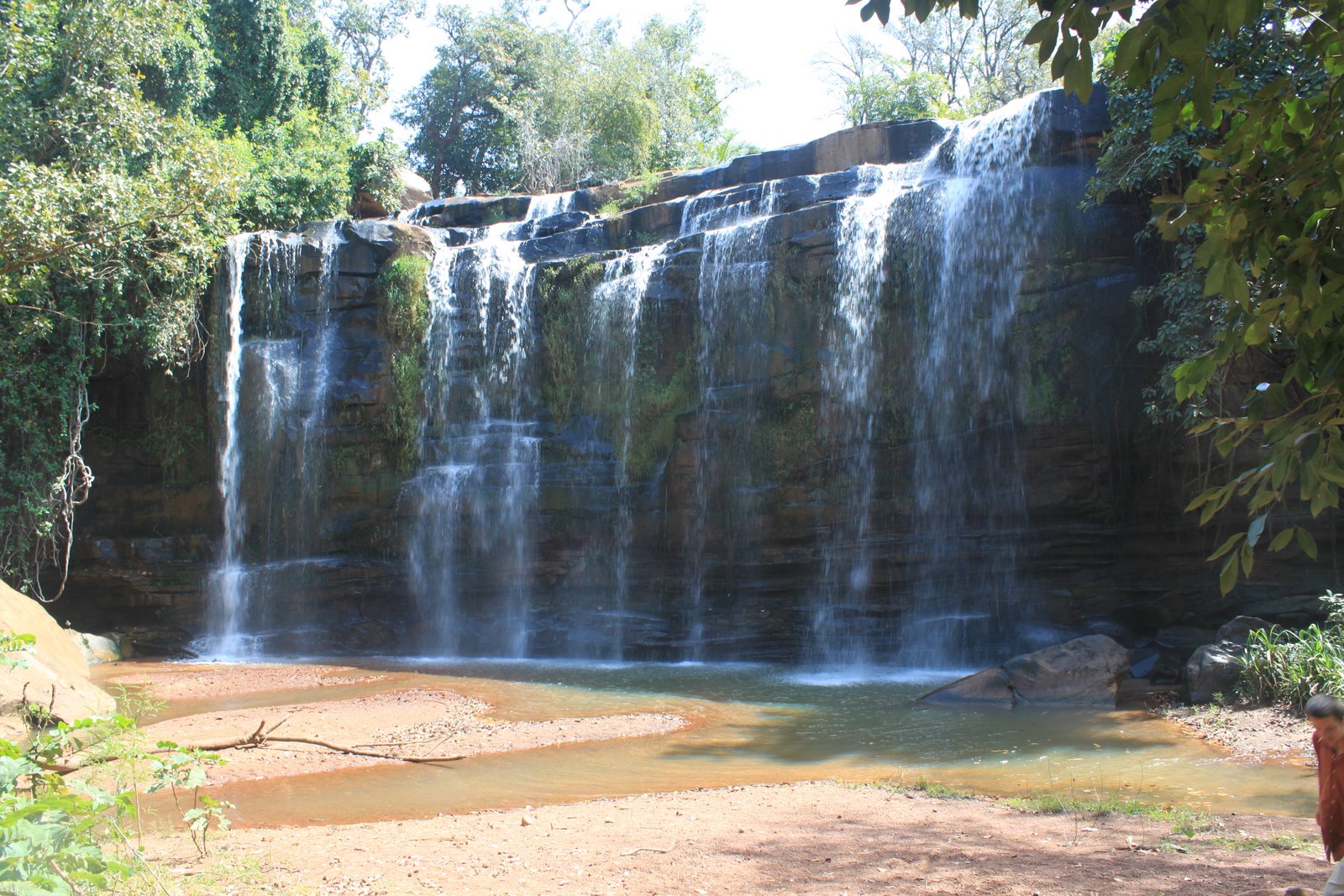
We had a pool party and Mexican dinner on Friday, and then headed out to some waterfalls for a camping trip over the weekend. The waterfalls were really cool to see and we had a great time camping by them, eating tons of guacamole and hanging out around the campfire.

This is the transport we took out to the waterfalls, a beat-up Peugeot 504. It's called a sept-place in Senegal because seven people travel in it with a driver, but in Guinea and Mali they cram as many people into them as they can. I think we fit 12 people into the one I was in. It's definitely not a comfortable ride! This car has seen better days.

One of the many stops to fill up for gas or put some other unknown fluid into the makeshift engine.

The waterfalls.

Our campsite. Looks like an REI commercial!

Tabaski 2010

On November 17th, Muslims around the world celebrated a holiday called Eid al-Adha, or Tabaski in West Africa. It’s also known as Seliba, which means big prayer in Bambara. Here’s a short summary from Wikipedia:
Eid al-Adha is an important religious holiday celebrated by Muslims worldwide to commemorate the willingness of Abraham (Ibrahim) to sacrifice his son Ishmael (Isma'il) as an act of obedience to God, before God intervened to provide him with a ram to sacrifice instead. The meat is divided into three parts to be distributed to others. The family retains one third of the share, another third is given to relatives, friends and neighbors, and the other third is given to the poor & needy.

This is the time when Muslims make the pilgrimage to Mecca, which they are supposed to do at least once in their lives if they can afford the trip. Here in Mali, Tabaski is the biggest holiday of the year. Families save up for the big feast and buy a sheep to sacrifice if they can afford it. About a week before the holiday, women started to braid each other’s hair, kids were fitted for nice new clothes, and animal herders came into town to sell their sheep. Families save up a lot of money for Tabaski to buy a sheep to sacrifice for the holiday feast.

This year my host family was fortunate enough to buy two sheep for the feast. Each day, my host brother would bring the sheep over and tie them up in my yard during the day. It was nice to have some sheep around for a week, since they ate all the overgrown grass and weeds that took over my yard during the rainy season. I didn’t get warmed up to the sheep since their days were numbered, but I did give them names: Taba and Ski. My host brother thought that was hilarious.

On the morning of Tabaski, all of the men in town went to a central location and all prayed together as the imam led the service. Once the imam had sacrificed his sheep, everyone could go home and do the same. Our sacrifice was especially graphic this year with two sheep to kill. As with tradition, my host dad delivered some of the sheep to an old woman in town, and also gave some to our neighbors.

The feast was plentiful; we ate two big courses during the day and another at night. As with every Malian meal, we all ate together, with our hands, in a shared bowl. We had salad, liver, fries, and bread for the first course, and Moroccan cous cous with onions for the second course. At night we had more meat and potatoes in an oily sauce. I haven’t been that stuffed in a long time!

Sunday, November 7, 2010

Mali-Senegal Bike Ride

For my latest trip out of site, I decided to bike to the Peace Corps house in Kedougou, Senegal. It's 135 kilometers (85 miles) from Kenieba to Kedougou. It's actually the closest Peace Corps house to Kenieba, as Kayes (the house I usually go to) is 250 km and Kita is 210 km on a road under construction. There is public transport on most of the route, but I decided to ride my bike on the 85 mile route from Mali to Senegal.

It is not as crazy as it sounds; Senegal PCVs have ridden the route and stayed with me in Kenieba, including my friend from high school last January. The road is in perfect condition, recently paved and little to no traffic on the whole route. I counted a total of 20 cars or trucks that passed me the entire day. I had plenty of fallbacks in case I ran into bike trouble or was too tired to keep going; there are Peace Corps volunteers working in Saraya, a town two-thirds of the way to Kedougou. I also brought a ton of Power Bars and granola bars that my parents and grandparents sent over in care packages, and I took two Nalgene bottles and a couple half liter bottles with me, and had Gatorade drink packets to mix in with the water. So I was well prepared for the ride!

I got up before sunrise, strapped my backpack on the back of my bike, locked up the house and and began my ride to the border at 6:45 AM. The road is not paved yet on the Mali side but it's graded and well-maintained, and easy to bike on. The toughest part was shielding my face from the dust cloud that would appear after pickup trucks carrying construction workers would pass. The bridge workers head out to the construction site each morning. The bridge is not finished and the water level is too high right now to wade across (since rainy season just ended), so I had pay $3 to cross the river in a dugout canoe. I held on tight to my bike to make sure it wouldn't fall into the river!


The road on the Mali side

The bridge under construction at the border

Once I reached Senegal, it was easy riding. The road is in perfect shape, a two lane road with packed gravel shoulders all the way from the border to Kedougou. There are milestones at every kilometer for the 112 km from the border to Kedougou, so I knew how much farther I had to go every kilometer of the trip.

It was fun to greet people in Malinké as I rode by. Some were harvesting their peanut crops, others were walking to or from school, and others just relaxing under a tree. There were a few Senegalese on their bikes who rode alongside me for a few minutes and we chatted a bit as we went along. I arrived at Saraya at 10:45 AM, way before I thought I would. I refilled my water bottles, had bananas and Biskrem cookies for brunch, and decided to continue riding while the air was still cool. Well, it was only like that for a little while longer, and it started to get really hot in the middle of the day. I took lots of breaks to escape the sun (and give my butt a break!) whenever I saw a big shady tree to stop under. I put 60+ sunscreen on before I left Kenieba and reapplied at my lunch stop, but I still got pretty burned under the African sun!

Crossing the Gambia river right before I arrived in Kedougou

After a few big hills right at the end, I arrived in Kedougou just before 3 PM. It has been fun to hang out with the Peace Corps volunteers here for the past few days and compare stories about life in Mali vs. Senegal. The house is not actually a house but a cluster of huts: two sleeping huts, a kitchen hut, library hut, and a big hangar to relax under. They also just got a really cute puppy who's been fun to play with.

The new house puppy in Kedougou

I'm headed back to Kenieba at sunrise tomorrow morning, and will be there for a few weeks. I'll be leaving next for the Peace Corps Thanksgiving party (including a full Thanksgiving dinner... turkey, pies and all) which should be a lot of fun!